Hand it to a process,not an API.
alma reads any document with a multi-agent pipeline — typed, handwritten, tables, maps, stamps, signatures — then verifies every field against cited evidence before it ships. Nothing is fabricated.
Trusted by archivists, registries and enterprise data teams
“Ezekiel A. Holder”
est 0.71
“Ezekiel Braithwaite”
est 0.69
both reads below threshold → escalated to a reviewer
amber + ✓ = a human confirmed it — not the machine
Verified, not generated
Drag the seam. Watch ink become a dataset you can trust.
Left, a 1911 conveyance in fading copperplate. Right, the same page after alma — every field boxed, scored, and linked to the exact pixels it came from.
Know all men by these Presents that I, Ezekiel A. Holder of the parish of Saint Michael, planter, in consideration of the sum of…
Five agents. One orchestrated pass.
A document is handed to a process, not an API — detected, read on two tracks, reconciled, and shipped only with the evidence behind it.
- text
- vision
- verified ✓ human
- escalated
& segment
- 01Detect & segment
Locate every field, table, stamp and margin note.
- 02Dual-track read
Text and vision models read each field on their own.
- 03Verify
Reconcile both reads into one scored, cited value.
- 04Export
Confirmed values ship as csv, json or API.
- 05Escalate
The doubtful ~3% goes to a human reviewer.
How it shows its work
Two readings. One value.
field · passenger.surname · ship's manifest, 1907
Neither track is trusted alone.
est = alma's estimate — only a human sign-off turns it amber + ✓
What's under the hood
Built to read what OCR gives up on.
Any document, any century
Digitize ships' manifests
Centuries of formats, one process — built for the archive, not the demo.
- Ship's manifestsurname ="Kowalczyk"· est 0.71
- Estate ledgeramount ="£240 14s"· est 0.88
- Birth registerborn ="1923-04-07"· est 0.93
- Cadastral mapparcel.id ="№1843/214"· est 0.90
- Census returnoccupation ="shipwright"· est 0.74
- Medical intakeblood_type ="O+"· est 0.82
- Conveyance deedgrantor ="Holder"· est 0.62
The product, not a pitch
See it in the app.
Real screens from the verifying app — every value scored, evidenced, and yours to check.
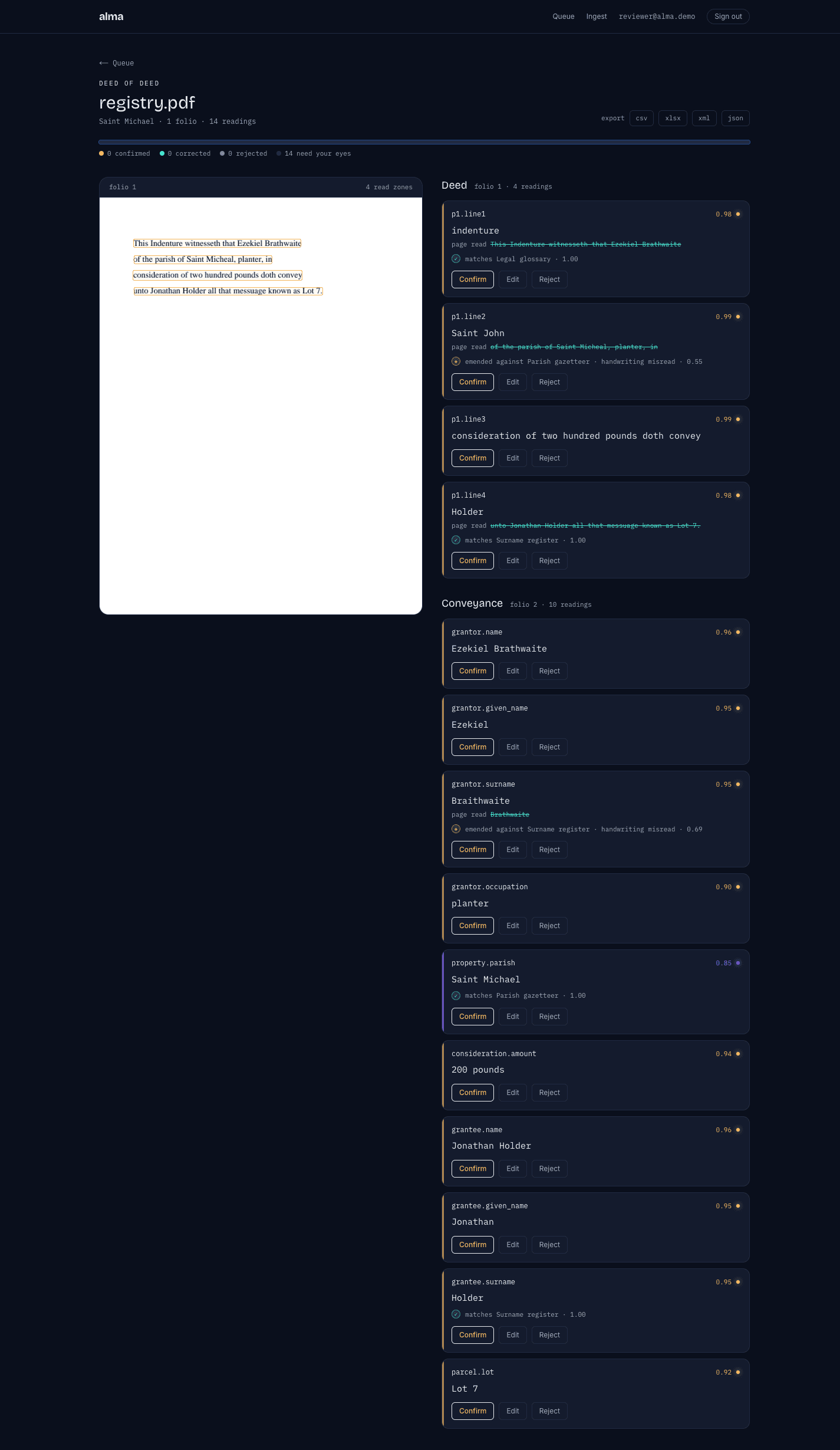
The Verifying Room
Reviewers see the scan and every reading side by side.
- scan ↔ readings, locked together
- confirm, edit or reject in a keystroke
- every field scored as you go
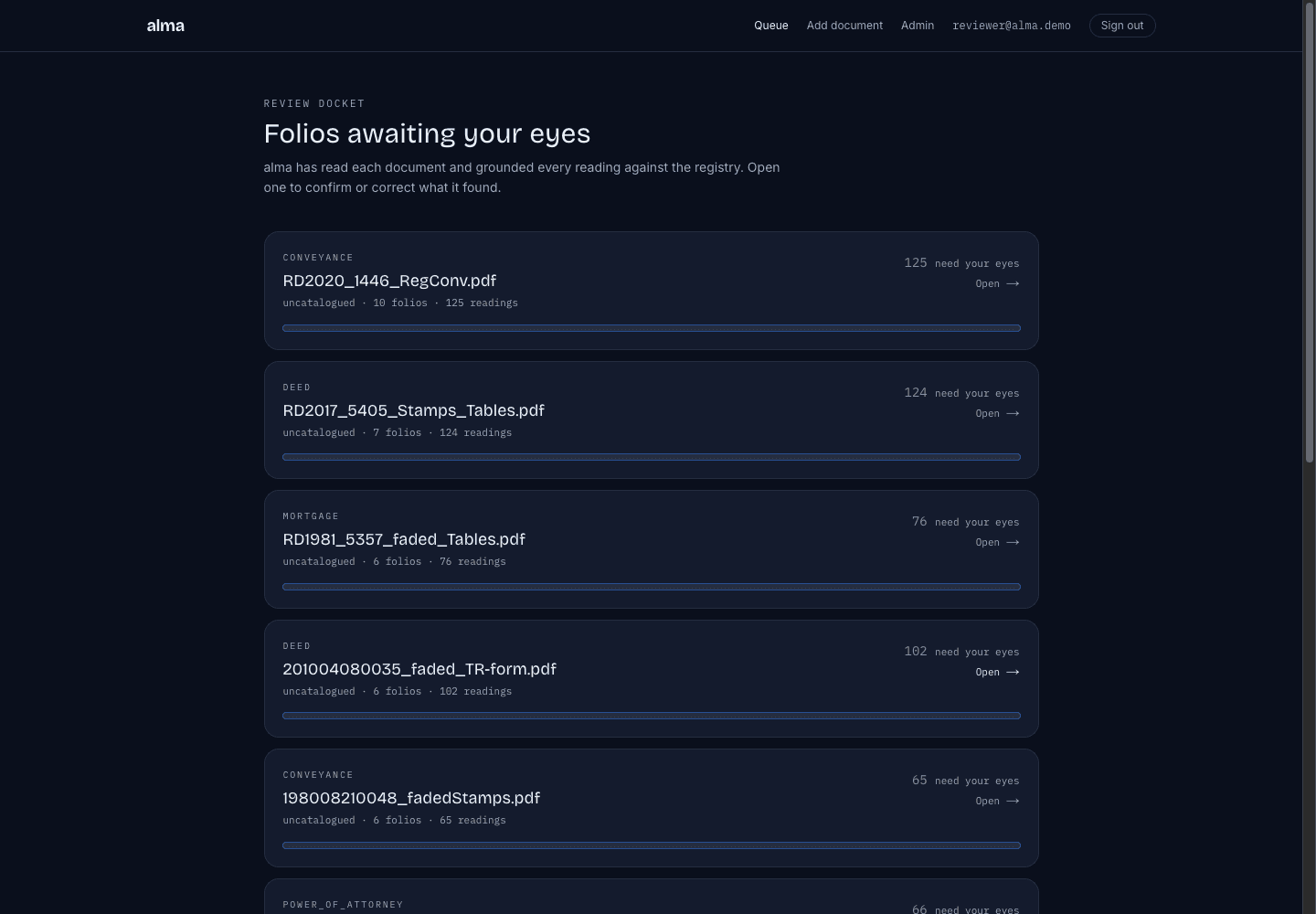
The review docket
Only the doubtful residue reaches a person.
- sorted by what needs you most
- deeds, manifests, ledgers, forms
- the easy 97% never lands here
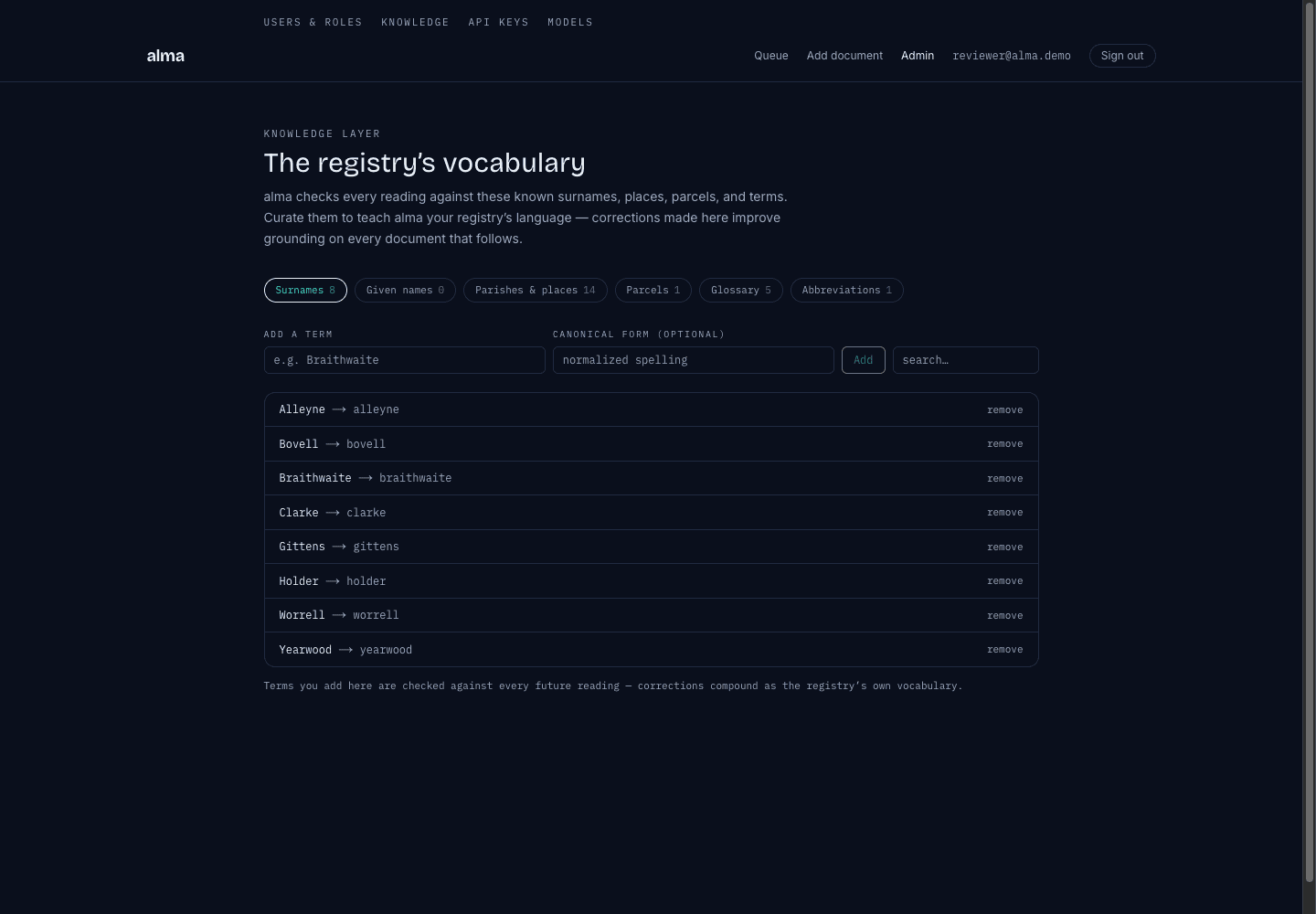
Knowledge grounding
Every reading checked against your own vocabulary.
- names, places, parcels, codes
- matches shown inline with each read
- your corrections compound over time
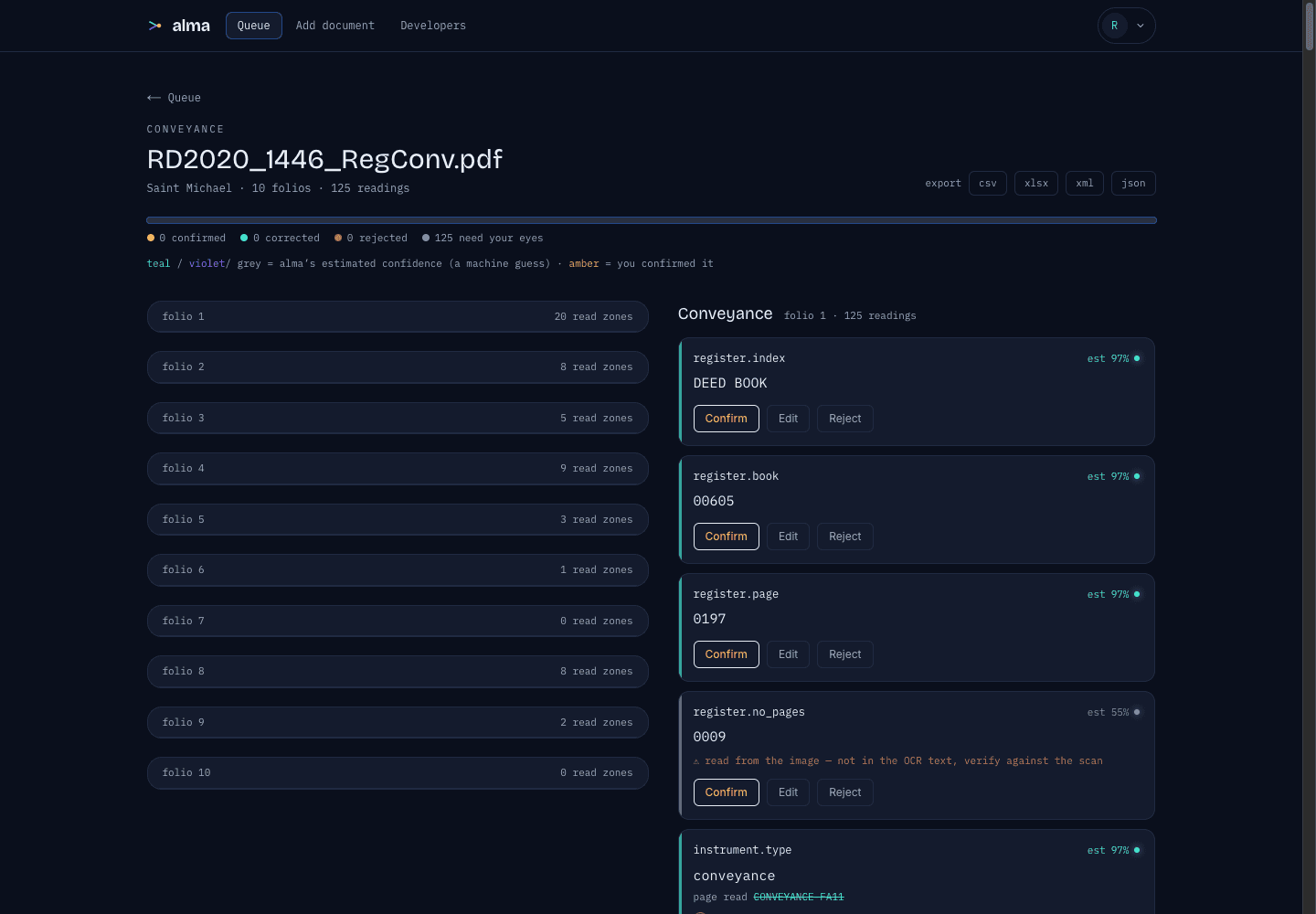
Per-field confidence
Each value carries a score, evidence, and a reason.
- value · score · evidence · reason
- export csv · json · xml · xlsx
- RBAC scoped on every key
A model you own.
Every correction your reviewers make is captured as training data. alma fine-tunes and distills a model specific to your archive — one you own, host how you choose, and call via API.
The Flywheel
The learning loop
Each lap, fewer fields need a human — and the model gets cheaper to run.
- occupation ="shipwright"· est 0.71alma readsmachine estimate
- you correcta human confirms
- corrections → training dataevery fix captured
- distilled modelyours to own
↺ reads better — next cycle
rising est = the machine reading better; only ✓ means a human confirmed it.
Call it from anywhere
One request. Cited fields back.
Invoke your own model over REST or MCP. Every field returns scored and evidence-linked.
Issue scoped keys; watch every call land.
$ curl -sX POST https://api.alma.intergentech.ai/api/v1/documents/4012/digitize \ -H "Authorization: Bearer $ALMA_KEY" \ -H "Prefer: wait=60" # 200 OK — finished inside the wait window# { "status": "succeeded",# "result": { "result_url": "/api/v1/documents/4012" } } $ curl -s https://api.alma.intergentech.ai/api/v1/documents/4012 \ -H "Authorization: Bearer $ALMA_KEY"{ "documentId": 4012, "docType": "ship_manifest", "fields": [ { "key": "passenger.surname", "value": "Kowalczyk", "confidence": 0.91, "status": "unreviewed", "evidence": { "page": 3, "bbox": { "x": 0.18, "y": 0.42, "w": 0.21, "h": 0.04 } } } ]}est = machine score; a ✓ appears only after a reviewer accepts.
webhooks on escalation · RBAC scopes on every key
Built for archives that matter
Enterprise control, archival discipline.
- RBAC at every step
Who can read, correct, and export — enforced on every action and every key.
- Evidence-linked audit
A tamper-evident trail on every field: who, when, what changed, and why.
- Self-host or VPC
Open-weight models you run in your own environment. Your data and model stay yours.
In production
- Barbados Land Registry · historical land records
- National archive · 40k handwritten pages
- Title insurer · auditor-signed exports
“40,000 pages of handwriting we'd written off as un-digitizable — alma gave us a queue of 900 to actually check.”
Head of Records — National Archive“The confidence scores are why our auditors signed off.”
VP Operations — Title Insurer“We own the model now. That changed the procurement conversation.”
CIO — Ministry of Lands
Stop posting documents to an API. Hand them to a process.
Bring alma your hardest archive — the faded, the handwritten, the irregular. We'll verify it, field by field, and leave you a model you own.